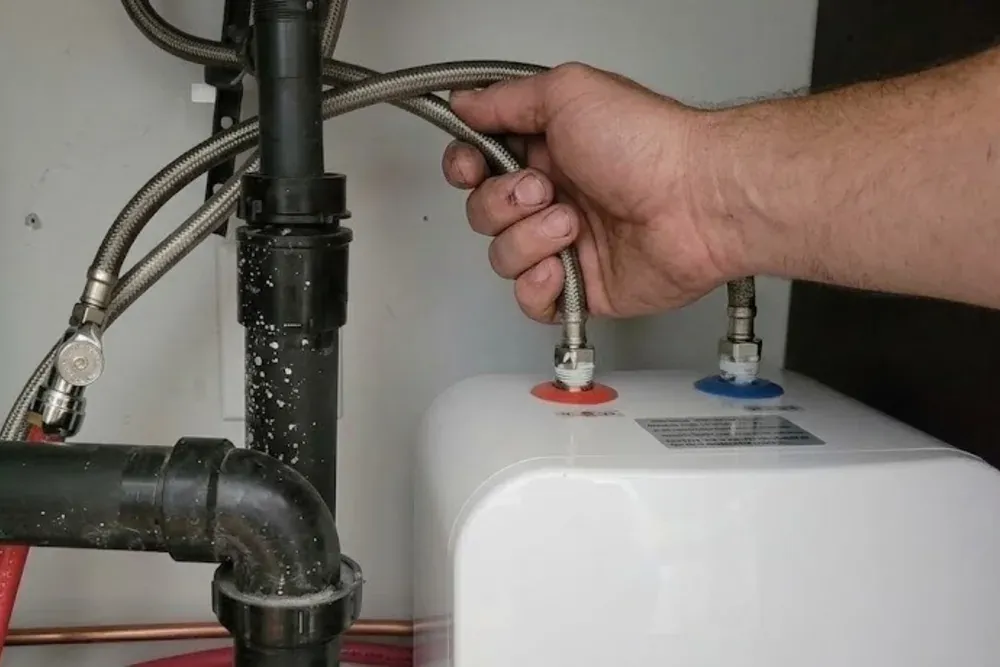
Why a heater needs an expansion tank
A heater in a closed system, one with a check valve or a pressure-reducing valve on the incoming line, has nowhere for expanded water to go. The pressure rises each time the burner or element fires, and the relief valve may open to protect the tank.
An expansion tank has a rubber diaphragm with air on one side and water on the other. The air compresses as the water expands and then pushes it back. When the diaphragm ruptures or the air pressure is lost, the tank fills with water and stops working.
Signs the tank has failed
- The relief valve drips or discharges during heating cycles.
- Water pressure at faucets spikes and drops.
- Pipes bang or knock when the heater comes on.
- Water leaks from the bottom of the expansion tank or from its air valve.
- Tapping the tank sounds dull and heavy all the way down, instead of hollow on top.
Press the air valve on the side of the tank. If water sprays out instead of air, the diaphragm has failed.
How replacement works
- 1
Shut off the water and power
Close the cold water supply, turn off the heater and open a hot tap to relieve pressure.
- 2
Drain the line
Open a faucet or the heater's drain valve to lower the water level in the line.
- 3
Remove the old tank
Unscrew it from the tee or fitting, and expect some water.
- 4
Set the air pressure
Check the new tank's air precharge with a gauge. It should match your household water pressure, which a gauge on a hose bib shows.
- 5
Install and support
Thread the tank on with thread sealant, and support it if the manufacturer requires it. Restore water, check for leaks and watch the pressure.
- 6
Restore power
Turn the heater back on after the tank is full.
What the code and the city say
Expansion tanks are a code item in many installations, and New Jersey's Uniform Construction Code governs plumbing work. Permit and inspection rules vary by municipality, so ask the Bridgeton construction office whether replacing the tank is considered maintenance or a permitted change for your address. The expansion arrangement is a plumbing subcode item under N.J.A.C. 5:23-3.15, which adopts the National Standard Plumbing Code.
A house on an open system may not have needed one in the past. When a newer pressure regulator or check valve was added at the meter, the expansion tank became necessary, and not every house got one. If your relief valve began to drip after a plumbing upgrade, that is probably why.
We make the same pressure checks for homes in Millville and Upper Deerfield Township, since a closed system behaves the same way anywhere.
Sizing and pressure matching
| Check | Why it matters |
|---|---|
| Household water pressure | The tank's air precharge must match it |
| Water heater size | A larger heater needs a larger expansion tank |
| Mounting position | Some tanks can hang vertically, others need support |
| Existing check valve or pressure regulator | These close the system and create the need for a tank |
An undersized or wrongly charged tank gives you the symptoms of a failed tank. We test the pressure first and match the unit to your heater, which is part of the work covered on our water heater installation page.
What affects the cost
- The tank. Sizes and brands vary.
- Access. A heater in a tight closet takes longer to work around.
- Pressure regulator. If your pressure is high, a pressure-reducing valve may be the real fix.
- Supports and fittings. Old fittings may need replacing.
- Related problems. A relief valve that has been weeping may need replacement too.
We give you a clear price before work starts. Call (856) 250-1784 to talk through your setup.
Testing your own water pressure
A simple pressure gauge screws onto an outdoor hose bib and reads static pressure in psi. Most homes sit between 40 and 80 psi. Anything above about 80 psi strains fixtures and the heater, and a pressure-reducing valve may be the real answer, not a larger expansion tank.
Read the gauge when no water is running, and again after the heater fires. A big jump during the heating cycle shows thermal expansion with nowhere to go. That is the exact reading that tells a plumber the tank has failed.
What to do if the relief valve is discharging, and what not to do
A failed expansion tank does not cause an immediate disaster, but it makes every heating cycle harder on the system. Relief valves wear out from repeated opening, supply hoses and fixture seals fail early, and the heater tank itself ages faster under pressure swings.
Replacing a tank is a small repair compared with a leaking heater or a burst supply line. If your relief valve drips or your pipes knock when the heater runs, do not wait for the next failure.
Do not ignore a weeping relief valve
A relief valve is a safety device, not a drain. Capping it or ignoring it is dangerous, because it protects the tank from over-pressure. If the valve drips, find out why, and replace both the valve and the failed expansion tank if needed.
Never plug the discharge pipe. If the heater is old and the tank is corroded, an expansion tank will not save it, and replacement is the right move.
Questions about this topic in Bridgeton
If your water system is closed by a check valve or pressure-reducing valve, usually yes. We check your setup and tell you.
Often around five to ten years, depending on pressure and water conditions.
Yes. A ruptured diaphragm can fill the tank with water, and the tank can leak at its seams or air valve.
Match the household pressure, measured with a gauge on a hose bib. Setting it wrong defeats the purpose.
Rules vary by municipality. Ask the Bridgeton construction office.
Often, but not always. High household pressure or a worn valve can cause the same drip. We test the pressure first.
Relief valve dripping?
Call and a plumber can test the pressure and tank.