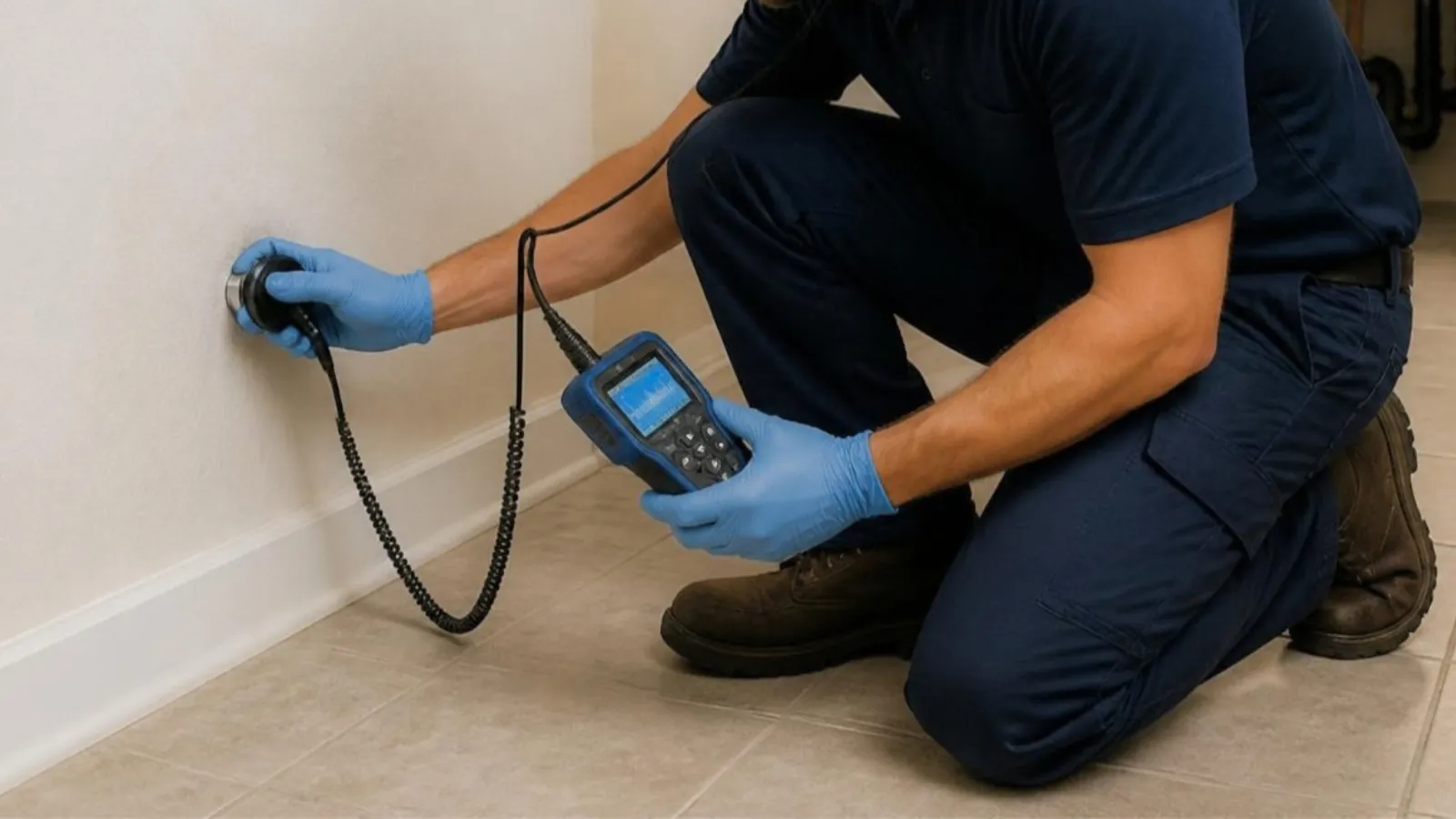
What jetting does and does not do
A jetting nozzle sprays high-pressure water against the walls of a drain pipe. It removes grease, scale, silt and roots. It does not find holes, and it does not seal them. If a pipe is cracked, jetting does not reveal that on its own.
Sometimes jetting uncovers a problem. When scale that was plugging a crack washes out, the leak starts to show. That is a side effect, not a method.
How a camera finishes the job
- 1
Clean the line
Jetting removes buildup that hides the pipe wall from the camera.
- 2
Run the camera
A waterproof camera on a cable shows the interior, cracks, offsets and roots.
- 3
Locate defects
A locator at the camera head marks depth and position above ground.
- 4
Plan the repair
The footage shows whether lining, a spot repair or replacement fits.
Drain leaks and supply leaks are different
| Leak type | How it shows up | Tool |
|---|---|---|
| Drain or sewer line | Wet soil, odor, repeat backups | Camera after cleaning |
| Water supply line | High bill, running meter | Meter test, acoustic and thermal tools |
| Slab leak | Warm floor spot, sound of water | Acoustic and thermal tools |
| Fixture or connection | Stain or drip under a sink | Visual check and pressure test |
A supply leak has nothing to do with jetting, and the meter test is the right first step. Camera work applies to drains and sewer lines, which our sewer inspection page covers.
Where groundwater and old pipe meet in Bridgeton
Bridgeton lies along the Cohansey River, and in low areas groundwater can enter cracked sewer pipe after storms. A drain that runs fine in dry weather and slows after heavy rain is a classic clue. A camera run in wet weather shows water entering at joints. Camera findings are often described using the NASSCO pipeline assessment standard, which gives defects a consistent name, and repairs follow N.J.A.C. 5:23-3.15.
Ask the Bridgeton construction office or your sewer authority where your responsibility ends before you plan a repair, and call 811 before any digging. The same wet-weather clue applies in Millville, where the Maurice River and Union Lake sit close to older neighborhoods, and in Upper Deerfield Township.
When to jet before a leak search
If a drain is slow and you suspect it is cracked, jet first, then camera. The jetting makes the camera footage useful. If the drain flows well, skip the jetting and camera it directly.
If the suspected leak is on the supply side, do not jet. Close every fixture, read the water meter, wait an hour and read it again. Movement means a leak somewhere.
What affects the cost
- Scope. Jetting, camera and locating are separate tasks.
- Length of line. More pipe means more time.
- Access. Cleanouts keep the job short.
- Findings. A repair afterward is a separate price.
- Hour of the call. After-hours dispatch can be priced differently.
We give you a clear price before work starts. Call (856) 250-1784 and describe what you see.
What to tell the plumber before the visit
Describe the symptoms in detail: which drains are slow, how long, whether anything changed after rain or a plumbing repair and whether you have seen wet spots or smelled sewage. Mention the age of the house and any past sewer repairs or root problems.
A good description saves time and money. It lets the plumber bring the right equipment, whether that is a cable, a jetter, a camera or a leak-locating tool.
After the inspection
Ask for the camera footage and a written summary of what was found. If the pipe is sound, you may need only a cleaning schedule. If it has defects, the footage guides the repair, whether that is lining, a spot repair or replacement.
Keep the footage. It is useful for insurance, for selling the house and for comparing quotes. Take your time with the decision unless water is actively coming into the house.
Reading the signs
- A drain that is slow only after rain may be taking in groundwater through a crack.
- A damp patch in the yard along the sewer line suggests a leak in the lateral.
- A sewage smell at the foundation points to a broken joint or a dry trap.
- A high water bill with no drain symptoms points to the supply side.
- A repeat clog in the same spot suggests a defect there.
These are clues, not proof. The camera and the meter test provide the proof.
Questions about this topic in Bridgeton
No. It cleans pipe. A camera finds defects, and a meter test finds supply leaks.
If the line is heavily coated or slow, yes. A clean pipe gives a clear picture.
On a weak or cracked pipe, yes, which is why we look first when the pipe is old.
Start with the meter test. See our leak detection page for the steps.
Done with the right nozzle and pressure, no. We tell the crew about any lining first.
No. They are not construction. A repair afterward may need one.
Suspect a leak?
Call and describe the symptoms.