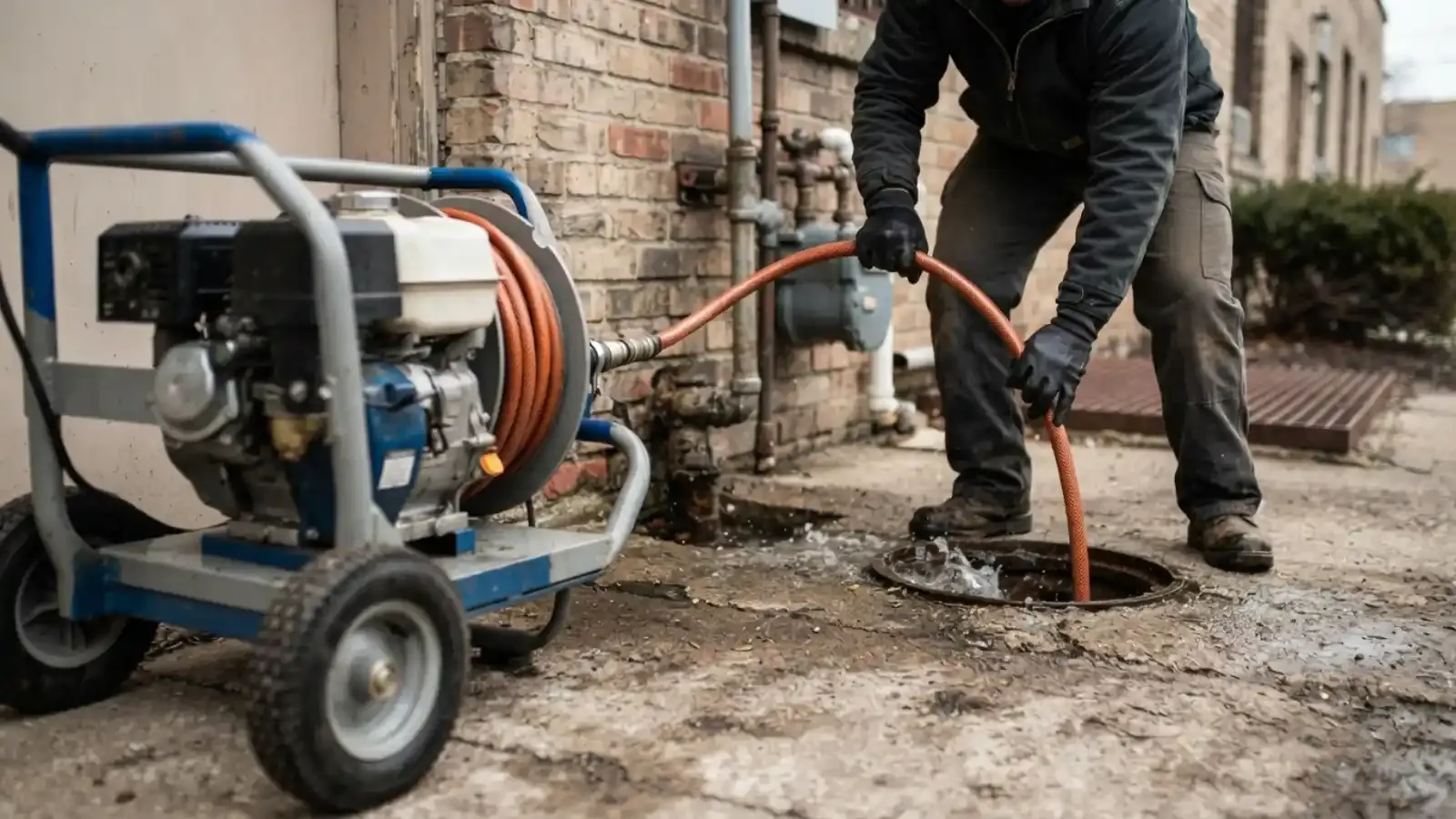
Why kitchen lines clog repeatedly
Kitchen drains carry fats, oils, food scraps and soap. Warm water carries grease down the pipe, and as it cools, the grease solidifies on the pipe wall. Layer by layer, the opening narrows, until a bit of rice or a coffee ground blocks it entirely.
A cable punches a hole through the blockage but leaves the film on the walls. The hole closes within weeks, and the clog returns. That is the pattern that points toward jetting.
What jetting does to a kitchen line
- 1
Camera first when possible
We look at the pipe's condition so we do not jet a weak or broken section.
- 2
Insert the nozzle
A hose with a rear-facing nozzle goes in through a cleanout or access point.
- 3
Pull back and scour
Water fires backward and pulls the hose along while it strips grease and scale from the wall.
- 4
Flush and test
Debris flows to the cleanout and out, and we run water to confirm the flow.
Jetting compared with other options
| Method | Best for | Limit |
|---|---|---|
| Plunger or hand auger | A simple trap clog | Does not clean the pipe |
| Cable machine | A solid blockage in the line | Leaves a film behind |
| Hydro jetting | Grease and scale on pipe walls | Not for damaged pipe |
| Enzyme or bacterial treatments | Light buildup, maintenance | Slow, no help for a full clog |
Our hydro jetting page covers the equipment and the cost factors in more detail. The takeaway is that jetting is a cleaning method, not a repair.
Older kitchen lines in the Historic District
Bridgeton's Historic District covers about a quarter of the city and includes more than 2,000 properties. We do not assume what pipe any kitchen has. Where a kitchen drain runs through several elbows, every elbow is a place where grease catches. Jetting equipment is used according to the manufacturer's guidelines, and the pipe it cleans was installed to the plumbing subcode (N.J.A.C. 5:23-3.15).
Before we jet an older line, we ask about the pipe material and look with a camera if we can. A sound cast iron line takes jetting well, and a patched clay line may not. Ask the Bridgeton construction office about permit rules if a repair, not just a cleaning, turns out to be necessary.
Older kitchens in Millville, a city whose town plans were drawn in 1795 around a mill dam on the Maurice River, and in Vineland show the same pattern of long drain runs and old elbows.
Is jetting safe for my pipes?
On sound pipe, yes. On cracked, collapsed or heavily corroded pipe, high pressure can make things worse. That is why a camera look comes first on an older line, and why we adjust the pressure and nozzle for the pipe size.
Kitchen lines inside a house are small, often two inches. Jetting those requires a smaller machine and nozzle than a main sewer line. Many jobs on interior lines are done with a small-diameter jetter from a cleanout.
What affects the cost
- Pipe length and diameter. More pipe means more time.
- Access. A cleanout makes the job short.
- Condition of the line. A camera before and after is a separate step.
- Buildup. Heavy grease takes longer than light scale.
- Hour of the call. After-hours dispatch can be priced differently.
We give you a clear price before work starts. Call (856) 250-1784 for your number.
What a jetting visit looks like in a home
The plumber sets up at the cleanout, which may be in the basement or outside the house, and protects the floor around it. The jetter hose runs into the line, and the water supply comes from a truck-mounted tank or the house. The visit is noisy but not messy when it is done well.
You can help by clearing the area around the cleanout and telling the plumber what you have noticed, such as which fixtures are slow and when. After the work, run the kitchen sink for a few minutes to confirm the flow.
How often is too often
If a kitchen line needs jetting more than once or twice a year, the cause is probably a defect, not buildup. A camera look finds a sag, a bad joint or a collapsed section that keeps catching debris. Jetting again and again on a damaged line is money spent on a symptom.
In that case, the next step is repair. Our guide to sewer line repair explains the options when a pipe will not stay clean.
Keeping grease out for good
- Wipe greasy pans with a paper towel before washing.
- Pour cooled fat into a can and put it in the trash.
- Use a strainer in the sink and empty it in the trash.
- Run cold water when using the disposal.
- Schedule a cleaning if you cook a lot and the line slows.
Jetting resets the pipe. Your habits decide how long it stays clean.
Questions about this topic in Bridgeton
When the line clogs again soon after a cable visit, or the cable stalls, or the line is slow throughout the house.
Not on sound pipe. We camera-inspect older or unknown lines before jetting.
It depends on the cooking and the pipe. A busy kitchen may need it more often, and many homes never need it.
We advise against it on a standing clog. It sits in the pipe and does not clear grease on the walls.
No. A disposal jam is a mechanical problem. See our disposal repair page.
Often yes, if the pipe is sound. We camera-inspect first when the material is unknown, since patched clay or thin cast iron can fail under pressure.
No. It is cleaning, not construction. A repair that changes piping may be.
Kitchen sink clogging again?
Call and ask whether jetting makes sense.